
Periprosthetic Shoulder Fracture
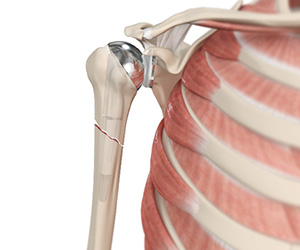
What is a Periprosthetic Shoulder Fracture?
A periprosthetic shoulder fracture is a fracture that occurs in the bone adjacent to a shoulder prosthesis.
What are the Risk Factors for a Periprosthetic Shoulder Fracture?
The risk factors for a periprosthetic shoulder fracture are:
- Reduced bone mineral density (osteoporosis or osteopenia)
- Female sex
- Advanced age
- Rheumatoid arthritis
How is Periprosthetic Shoulder Fracture Classified?
Periprosthetic fractures can be classified based on the location of the fracture in relation to the implant stem tip within the arm bone (humerus).
- Type A: Fracture is present near the stem tip, extending towards the shoulder
- Type B: Fracture is present near the stem tip, extending towards the elbow
- Type C: Fracture is present away from the stem tip towards the elbow
How is a Periprosthetic Shoulder Fracture Diagnosed?
Your doctor will perform a careful physical exam to ensure blood vessels and nerves passing near the fracture site have not been injured. Imaging studies such as X-rays and CT scans may also be ordered to evaluate implant stability, bone quality, and soft tissues.
How is a Periprosthetic Shoulder Fracture Treated?
Nonoperative treatment with a fracture brace may be an option if:
- The fracture is located below the implant stem tip
- There is acceptable fracture alignment
- The prosthesis is well fixed
When the fracture line crosses the tip of the prosthesis and extends towards the elbow, open reduction and internal fixation (ORIF) of the fracture may be required. This can be achieved with the surgical placement of plates and screws or surgical wires to stabilise the fracture. Replacement with a long-stemmed implant that extends beyond the fracture line may also be required.
Revision surgery to replace the implant should be considered when the fracture line encompasses most of the shoulder prosthesis or if there is a loosening of the prosthesis.
What is the Prognosis for Periprosthetic Shoulder Fracture Fixation?
Overall, the prognosis is good as many cases can be treated nonoperatively. However, fixation of periprosthetic shoulder fractures can be very complicated, and each case is treated individually, depending on the severity of the fracture and the condition of the prosthesis.
Patient Services and Care Coordination
Our team can assist with appointments and general inquiries.