
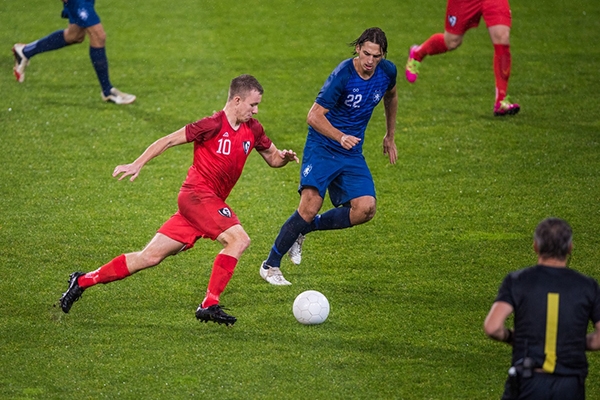
One awkward landing, a sudden pivot on the soccer field, or a quick stop on the basketball court can leave your knee feeling loose and unreliable. If you heard a pop and your knee has not felt stable since, you may be wondering whether surgery is in your future. This guide explains how ACL tears happen, who benefits from reconstruction, and what recovery involves so you can decide with confidence.
What the ACL Does and Why a Tear Changes Everything
The anterior cruciate ligament, or ACL, runs through the center of your knee and connects your thighbone to your shinbone. It keeps the shinbone from sliding forward and helps control rotation, which is exactly what you rely on when you cut, pivot, or land from a jump. A torn ACL does not heal on its own, and that loss of stability can make your knee feel as though it might buckle during everyday twisting movements.
How ACL Tears Happen and the Symptoms to Watch For
Most ACL tears are sports-related. They often occur when your foot is planted and your knee twists, when you stop or change direction suddenly, when you land incorrectly from a jump, or during a direct collision such as a football tackle. Soccer, football, basketball, tennis, and skiing are frequent culprits, and ACL tears, like cartilage damage and meniscal tears, are common knee sports injuries.
At the moment of injury, you may hear a pop and feel your knee give way. Swelling usually follows within the first couple of hours, and you may notice a buckling sensation when you twist or turn. Because an ACL injury can occur alongside other damage, such as meniscal tears, a thorough evaluation with a physical exam and imaging such as an MRI is important.
Do You Need ACL Surgery? What a Sports Medicine Specialist in Doral Considers
Not every ACL injury requires an operation. If the overall stability of your knee is intact, a sports medicine specialist in Doral or Miami may recommend nonsurgical care. This typically includes rest, ice, compression, and elevation to control pain and swelling, physical therapy to rebuild motion and strength, and a knee brace for support.
ACL reconstruction becomes a stronger consideration when:
- Your knee continues to feel unstable or gives way during daily activities
- You play pivoting sports and want to return to them safely
- Your tear is accompanied by other knee ligament injuries or meniscus damage
- Your work or lifestyle demands a stable, reliable knee
Your age, activity level, and personal goals all shape the recommendation, so the decision is one you make together with your surgeon.
What to Expect From ACL Reconstruction in Miami and Doral
If you are weighing ACL reconstruction in Miami or Doral, it helps to understand what the procedure involves. ACL reconstruction surgery replaces the torn ligament with a tissue graft, most commonly taken from your own body. Typical graft sources include the patellar tendon or a hamstring tendon, and in some instances the quadriceps tendon. In rare cases, a donor graft is used.
The operation is usually performed under general anesthesia using a minimally invasive arthroscopic technique. Through a few small incisions, your surgeon uses a tiny camera to view the joint, removes the torn ligament, creates small tunnels in the thighbone and shinbone, and secures the new graft in place.
Recovery After ACL Surgery: A Gradual, Therapy-Guided Process
Recovery from ACL reconstruction in Doral or Miami is a step-by-step journey rather than a quick fix. Early on, you can expect some swelling and discomfort, time with your leg elevated, and crutches with specific guidance on how much weight to place on your knee. An individualized physical therapy plan then helps you rebuild strength, motion, and balance as activities are increased gradually.
Returning to sports depends on your progress, not the calendar alone. Your care team will assess your strength, stability, and functional performance before clearing you for athletics, a process measured in months. Following your rehab plan closely helps protect your new graft as it heals.
Frequently Asked Questions About ACL Reconstruction
Can a torn ACL heal on its own without surgery?
A torn ACL does not heal on its own. However, if your knee remains stable and you do not plan to return to pivoting sports, nonsurgical care with physical therapy and bracing may allow you to manage daily activities comfortably.
How do I know if I tore my ACL?
Common signs include a popping sound at the time of injury, swelling soon afterward, and a feeling that your knee is giving way. A physical exam and imaging such as an MRI help confirm the diagnosis.
What graft is used for ACL reconstruction?
Most reconstructions use your own tissue, typically from the patellar tendon, a hamstring tendon, or sometimes the quadriceps tendon. A donor graft may be used in rare cases, and your surgeon will explain the options that fit your situation.
How long does it take to recover from ACL reconstruction?
Recovery is gradual and guided by physical therapy. You can usually resume everyday activities well before sports, and your return to athletics depends on meeting strength, stability, and functional milestones rather than a fixed date.
Is ACL reconstruction done arthroscopically?
Yes. ACL reconstruction is usually performed with a minimally invasive arthroscopic technique that uses small incisions, a camera, and miniature instruments, allowing your surgeon to view and work inside the knee.
Take the Next Step Toward a Stable Knee in Miami or Doral
If your knee feels unstable after an injury, an evaluation can help you understand whether surgery or a nonsurgical path is right for you. You can request an appointment online or call to schedule a visit at our Miami or Doral office.
Dr. Rafael Sanchez, MD, FAAOS, is a board-certified, fellowship-trained orthopedic sports medicine surgeon serving Miami and Doral. He earned his medical degree at Georgetown University and completed a five-year orthopedic surgery residency at Jackson Memorial Hospital. His traveling sports medicine fellowship took him to train with leading sports medicine and shoulder surgeons in New York, Denver, Vail, and Connecticut. A former athlete, he helps active patients get back to activities they love.